How to Identify Fireflies by Flash Pattern and Color
How to identify fireflies starts with knowing what you're looking at: fireflies, or lightning bugs, are beetles in the family Lampyridae, not true flies or true bugs. More than 2,000 species exist worldwide, and in North America the genus Photinus accounts for many of the backyard sightings on warm summer evenings. Telling species apart comes down to size, color, flash timing, and habitat, not just "the glowing bug."
Why Fireflies Glow
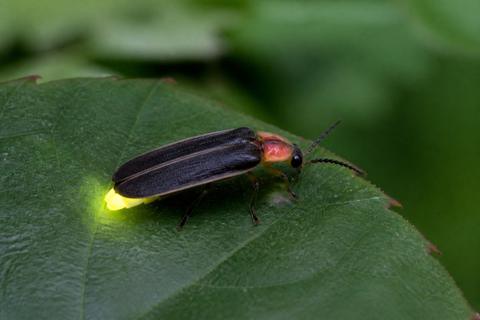
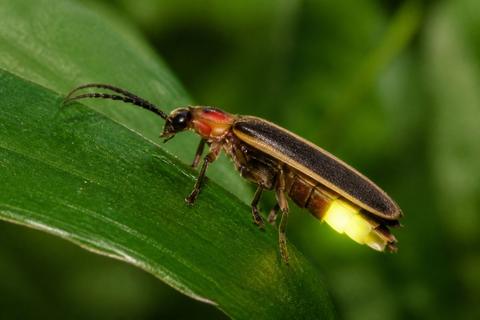
Fireflies aren't true flies; they're soft-bodied beetles with flexible elytra (wing covers) instead of the hard shell most beetles have. Light comes from an organ in the lower abdomen called a lantern, where the compound luciferin reacts with the enzyme luciferase in the presence of oxygen and ATP. The reaction converts luciferin to oxyluciferin and releases energy as light rather than heat, which is why the glow is often called "cold light."
Males patrol at dusk and flash a species-specific pattern; females, usually perched in vegetation, answer with their own flash after a set delay. That call-and-response is the single most reliable identification cue in the field.
Size, Shape, and Elytra
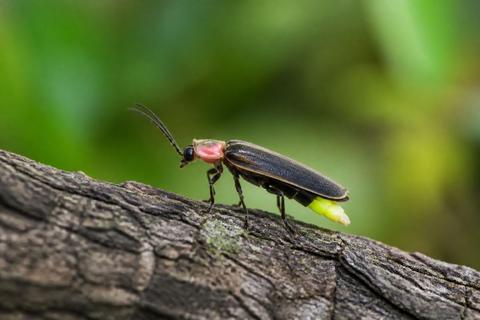
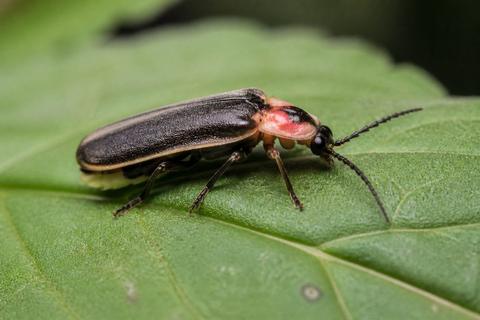
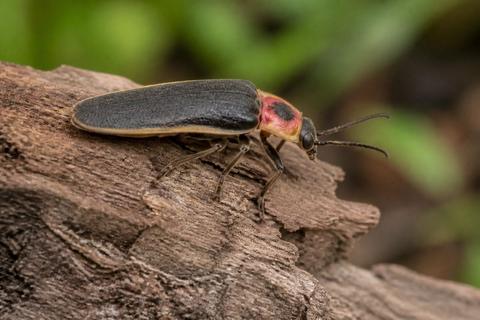
Adult fireflies mostly range from about 5 to 20 millimeters long, with a flattened, elongated body and a pronotum (the shield-like plate behind the head) that often extends forward over the head like a hood. The Big Dipper firefly (Photinus pyralis), one of the most common lawn species in the eastern and central US, runs roughly 9 to 15 millimeters and has a pink pronotum with a black central dot.
Color Patterns to Check
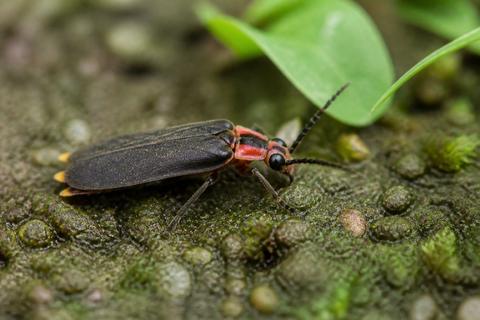
Most fireflies have dark brown or black elytra with yellow or orange margins, but the details vary by species:
- Big Dipper firefly (Photinus pyralis): black elytra edged in yellow, pink pronotum with a black center dot.
- Photuris species: often larger and duller in color; several species in this genus are visually near-identical and are separated mainly by flash behavior, not markings.
- Blue ghost firefly (Phausis reticulata): instead of flashing, males emit a steady, pale blue-green glow rather than a pulsing pattern, found in Appalachian forests.
Reading Flash Patterns
Flash timing is the fastest way to separate look-alike species in the same yard:
- Photinus pyralis: males fly a J-shaped upward loop with a single flash near the top, repeating roughly every 5 to 7 seconds; females answer 1 to 2 seconds after a male's flash.
- Photuris females: some mimic the answering flash of Photinus females to lure and eat Photinus males, a behavior researchers call "femme fatale" mimicry.
Count the seconds between flashes and note the flight path (looping, hovering, zigzag, or a slow steady glow) before checking a field guide.
Where to Look
Habitat narrows the possibilities before you even see a flash:
- Wet ground: most larvae and many adults depend on moist soil, stream edges, or marshes, since firefly larvae hunt snails and earthworms in damp leaf litter.
- Forest edges: species like the blue ghost stay low in wooded understory rather than open lawns.
- Open fields and lawns: Photinus pyralis is the species most people see flashing over grass at dusk.
Tools That Help
Field Guides
A regional beetle or firefly field guide gives you the local species list, since flash patterns and coloration described above only hold within a given range.
A Stopwatch
Timing the interval between a male's flashes, and the delay before a female answers, does more for identification than a photo, since many species look nearly identical at rest.
Recording Apps
Community science apps built for firefly monitoring let you log flash color, interval, and location, and some feed directly into regional population surveys.
Look-Alikes That Aren't Fireflies
A few insects get mistaken for fireflies:
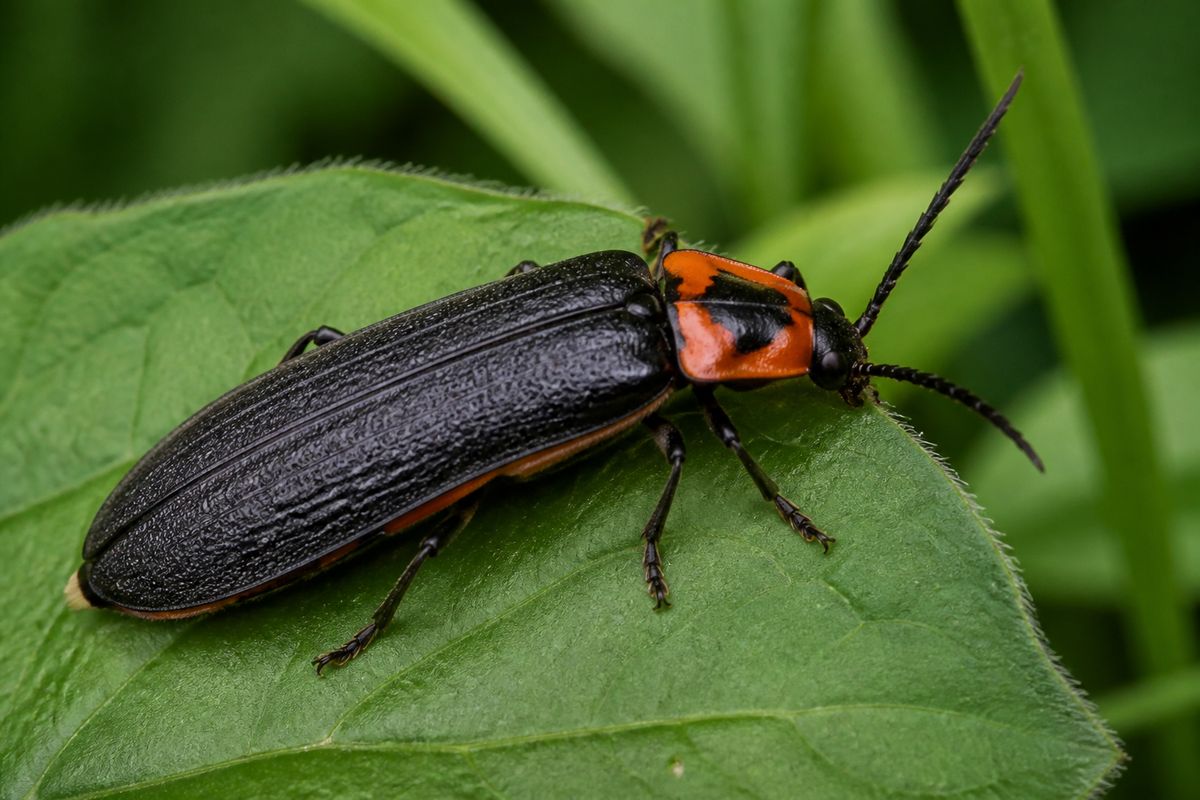
- Click beetles: similarly elongated but lack a light organ; they're known instead for the audible click of their thoracic hinge.
- Railroad worms and glow-worms: related lampyrid larvae or larviform females that glow but don't fly or flash in patterned sequences.
If the insect isn't flashing in a repeating rhythm and lacks the soft, hooded pronotum, it's probably not a firefly.
Firefly Populations Are Shrinking
Habitat loss and degradation are major drivers of firefly decline, alongside artificial light that disrupts the flash signals fireflies depend on to find mates, and broad-spectrum insecticides used in agriculture and residential pest control. Because many species need consistently moist ground for their larvae, draining wetlands or over-watering with runoff-heavy irrigation can remove a population's habitat even where adults are still seen flying nearby.
Cutting outdoor lighting during firefly season, mowing less often, leaving leaf litter where larvae overwinter, and skipping lawn pesticides all reduce pressure on local populations.
Putting It Together
Identifying fireflies means stacking a few field cues rather than relying on one: body size and pronotum color, the shape of the flight path, the number of seconds between flashes, and the habitat you're standing in. A Big Dipper firefly's J-shaped loop and 5-to-7-second flash interval look nothing like a blue ghost's steady glow, even though both are Lampyridae. Watch for ten minutes at dusk with a stopwatch and most yards will sort into two or three distinct species.
Sources
- Scientific Reports (Nature), peer-reviewed: "Genomic and experimental data provide new insights into luciferin biosynthesis and bioluminescence evolution in fireflies"
- LSU AgCenter (Louisiana State University Agricultural Center), extension fact sheet on Photinus pyralis
- PMC (peer-reviewed): "Illuminating Firefly Diversity: Trends, Threats and Conservation Strategies"