Where Do Paper Wasps Live? Under Eaves and in Woodlands
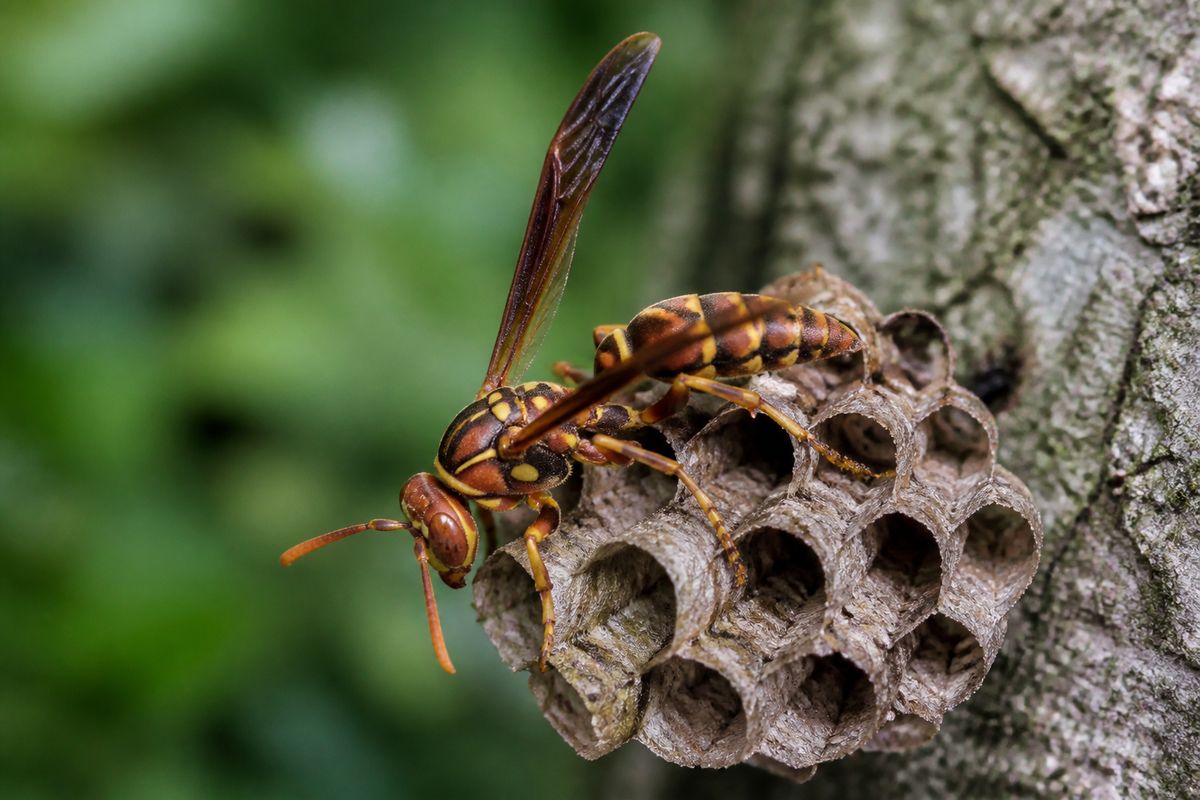
Where do paper wasps live? Mostly wherever there's a dry overhang and something to hunt nearby. Paper wasps (family Vespidae, genus Polistes) build open, umbrella-shaped combs of chewed wood fiber and saliva, and they hang those nests under eaves, in attics, inside porch furniture, and along tree branches and shrubs in the wild. Roughly 200 species exist worldwide, and in the United States the two you're most likely to run into are the native northern paper wasp (Polistes fuscatus) and the introduced European paper wasp (Polistes dominula).
What Counts as a Paper Wasp Nest
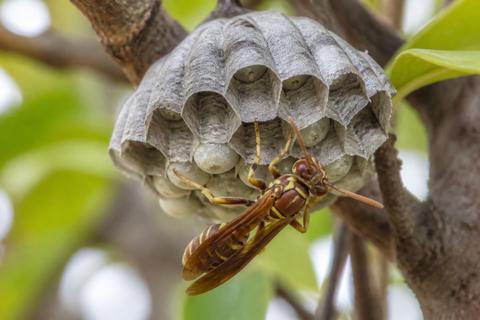
The nest itself is the giveaway: a single open layer of hexagonal cells, no outer envelope, with the whole comb hanging from a short stalk called a petiole. Workers scrape fibers off weathered fence posts, dead twigs, and unpainted wood, chew them with saliva into a pulp, and spread it into paper that dries into a water-resistant shell. Cornell's IPM program describes the material as "saliva mixed with chewed wood or paper litter," and notes nests turn up most often on the underside of eaves and overhangs, inside metal fence posts, and under unused equipment where rain can't reach them. That shelter requirement is the main reason paper wasps end up so close to people.
Nesting Sites Around Buildings
Door frames, window ledges, deck railings, mailbox posts, and the undersides of grills and patio umbrellas all offer the same thing a tree branch does: a horizontal surface to anchor a petiole, protection from direct rain, and easy flight access. A single mature colony typically stays in the range of a few dozen workers by late summer, small enough that a nest can go unnoticed in a porch corner for weeks. Because the queen picks the site alone in spring, removing a nest early, before workers hatch, is far easier than waiting until the colony is established.
Woodland and Field Habitat
Away from structures, paper wasps nest on shrub branches, in bramble thickets, under loose bark, and in tall grass or brush piles. Workers forage across these same areas for caterpillars, which they chew up and feed to the larvae, and for nectar to fuel their own flight. Wooded edges and unmown field margins tend to hold more colonies than deep forest interior, since dense caterpillar prey and open flight lanes both matter more than tree cover itself.
Range in North America
The northern paper wasp is native across the eastern and central United States and southern Canada. The European paper wasp tells a different story: it was first recorded in North America near Boston in the 1970s and has since spread across most of the northern half of the United States and into British Columbia, according to Colorado State University Extension, which also documents its establishment in Colorado, first recorded in Larimer County in 2001. In many regions it now outnumbers the native species around homes, partly because it will nest in a wider range of cavities, including dryer vents, grill lids, and mailboxes.
Range Outside North America
Polistes dominula is native to southern Europe, North Africa, and parts of the Middle East, and has also established populations in Australia, New Zealand, South America, and South Africa. In Asia, Polistes species range from temperate Japan and Korea down through tropical Southeast Asia, with nesting material shifting to whatever fiber is locally available, bamboo splinters in some regions, softwood in others. Australia's introduced Asian paper wasp (Polistes chinensis) has spread through coastal New South Wales and the North Island of New Zealand since arriving in the late 20th century, first recorded in New Zealand in 1979, often nesting in dense shrubs and under house eaves alongside native species.
Why They End Up Near Food Sources
Paper wasp colonies expand their hunting range wherever prey is concentrated, which is why gardens, orchards, and crop fields see heavier traffic through summer. A single colony can remove large numbers of caterpillars, armyworms, and other soft-bodied larvae over a season, functioning as a free pest-control crew for anyone willing to tolerate a nest at a distance. Adults also visit flowers for nectar and pick up pollen in the process, though they're incidental pollinators compared to bees.
Seasonal Movement
Only mated queens survive winter; the rest of the colony, workers and males alike, dies off in fall. Queens overwinter alone in bark crevices, woodpiles, wall voids, and attics, sometimes clustering with other queens in a shared crack. NC State's Plant Disease and Insect Clinic notes that these insects "overwinter as mated queens, the rest of their colonies having died out the previous year," and that queens become active again as spring temperatures rise. Each surviving queen then searches out a new nest site on her own and starts the next colony from scratch, so the location of last year's nest tells you nothing about where this year's will be.
Reading the Signs of an Active Nest
- Location: check eaves, porch ceilings, shed rafters, playground equipment, and shrub interiors first.
- Size: nests start as a single small comb in spring and grow to several inches across by late summer as more cells are added.
- Traffic: steady wasp movement in and out of one spot, especially in early morning, signals an active colony rather than an abandoned one.
Paper wasps aren't aggressive away from the nest, but a colony defends its comb hard once disturbed. Knowing the habitats above is mostly useful for spotting a nest early, before it grows large enough to make removal risky.