What Is the Life Cycle of Paper Wasps? From Egg to Adult
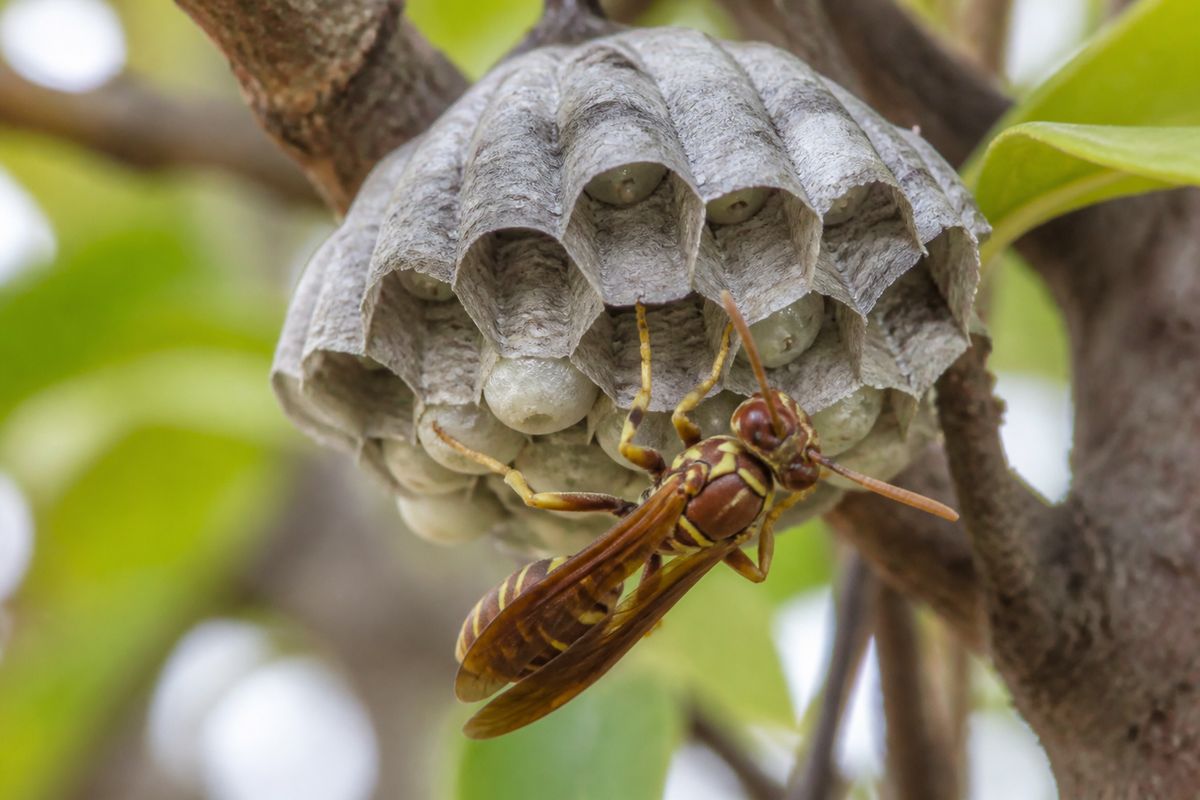
What is the life cycle of paper wasps? It runs through four stages, egg, larva, pupa, and adult, and a single generation completes it in three to four weeks. Paper wasps get their name from the gray, papery nests they build out of chewed wood fibers mixed with saliva, and unlike yellowjackets, they rarely bother people who leave the nest alone.
Family and Basic Biology
Paper wasps belong to the genus Polistes, part of the family Vespidae alongside yellowjackets and hornets. They have slender bodies, long dangling legs visible in flight, and open, umbrella-shaped nests with no outer envelope, so the hexagonal cells are visible from below. Most U.S. species are found from spring through fall in temperate regions and tolerate a wide range of climates.
The Four Stages, Egg to Adult
A single overwintered queen typically starts each colony alone in spring. She builds the first cells, lays the first eggs, and forages and feeds the larvae by herself until her first workers emerge, at which point they take over construction, hunting, and brood care while she focuses on egg-laying. In some cases several mated females found a nest together instead of a lone queen.
1. Egg
The queen lays one small white egg per cell, gluing it to the base. Eggs hatch after several days, with the pace depending on temperature.
2. Larva
Larvae are legless, eyeless grubs that sit head-down in their open cells and are fed directly by adults. Their diet is almost entirely caterpillars: paper wasps are voracious predators that kill soft-bodied prey, chew it into a ball, and carry it back to the nest to feed the brood. A larva molts several times and grows for roughly two weeks before it stops eating.
3. Pupa
The larva spins a silk cap over its cell and pupates inside, sealed off from the rest of the colony. Over about one to two weeks the body is rebuilt entirely, legs, wings, and compound eyes form, and the wasp emerges through the cap as a soft, pale adult that darkens within a day.
4. Adult
Development from egg to adult usually takes three to four weeks in total. Adults fall into three roles. Workers, all sterile females, build cells, hunt caterpillars, feed larvae, and defend the nest; most live only a matter of weeks and die off with the first hard frosts. Males appear later in the season, mate, and die shortly after. Mated females become next year's queens: they leave the nest, overwinter in bark crevices, leaf litter, or wall voids, and are the only members of the colony that survive winter.
What Paper Wasps Actually Do for a Yard
Because caterpillars make up the bulk of their diet, paper wasps function as a natural check on garden pests, and conservation programs have used nest boxes to draw them into crop fields for exactly that reason. They also visit flowers for nectar and move pollen between blooms as a side effect, though they are far less efficient pollinators than bees.
Nest Construction
Each nest starts as a short paper stalk anchored to a surface, with cells added outward in a single tiered comb. Nest size scales with colony size and the season length, from a few dozen cells on a small starter nest to several hundred by late summer.
Colony Hierarchy
Paper wasp colonies are not as strictly divided as honeybee hives. Multiple mated females sometimes found a nest together, and if the original queen dies, a dominant worker or co-foundress can take over egg-laying. Rank is maintained through aggressive posturing rather than a fixed caste system.
Sting Behavior
Paper wasps sting in defense of the nest, not while foraging, and a colony left undisturbed on a porch eave rarely causes problems. The sting itself is painful and, unlike a honeybee's, can be delivered repeatedly, but it is medically serious mainly for people with an allergy.
Seasonal Timing
Colonies are founded in spring, peak in worker numbers in mid to late summer, and produce the next generation of males and future queens in late summer or early fall. Once mating is finished, the old queen, all workers, and the males die off, and the nest is abandoned for good; it is never reused the following year.
Why the Life Cycle Matters
Every paper wasp nest is a one-season project. Knowing that a colony dies out completely each winter explains why an empty gray nest under an eave in October poses no risk, and why a founding queen in April building alone is the easiest time to relocate a nest if one has started somewhere inconvenient.