What Are the Characteristics of Honey Bees? Size to Sting
What are the characteristics of honey bees? A colony of Apis mellifera runs on three distinct body types, a scent-based communication system, and a caste structure that assigns nearly every task by age. Size, color, and behavior all shift depending on whether a bee is a worker, a drone, or the queen.
Size: Worker, Drone, and Queen Compared
A honey bee colony holds three castes, and each one has a different build for a different job.
Body Length by Caste
- Worker bees: about 12-15 mm long. Workers are sterile females and make up the vast majority of the hive, foraging for nectar and pollen, feeding larvae, and building comb.
- Drones: about 15-17 mm long, with noticeably larger compound eyes than workers, an adaptation that helps them spot and pursue a queen in flight during mating.
- Queen: 18-22 mm long, the longest bee in the hive, with a tapered abdomen that extends well past her folded wings.
Weight by Caste
A worker bee weighs roughly 90-120 milligrams. Drones run heavier, close to 200 mg, and queens weigh around 200-250 mg depending on how close they are to peak egg-laying. During peak season a healthy queen can lay more than 2,000 eggs in a single day, a rate that briefly exceeds her own body weight in eggs.
Color: What Gives Honey Bees Their Markings
A honey bee's coloring comes from a mix of cuticle pigment, hair, and genetics, not a single fixed pattern.
Banding and Hair
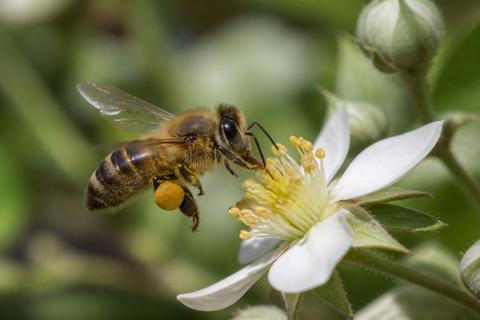
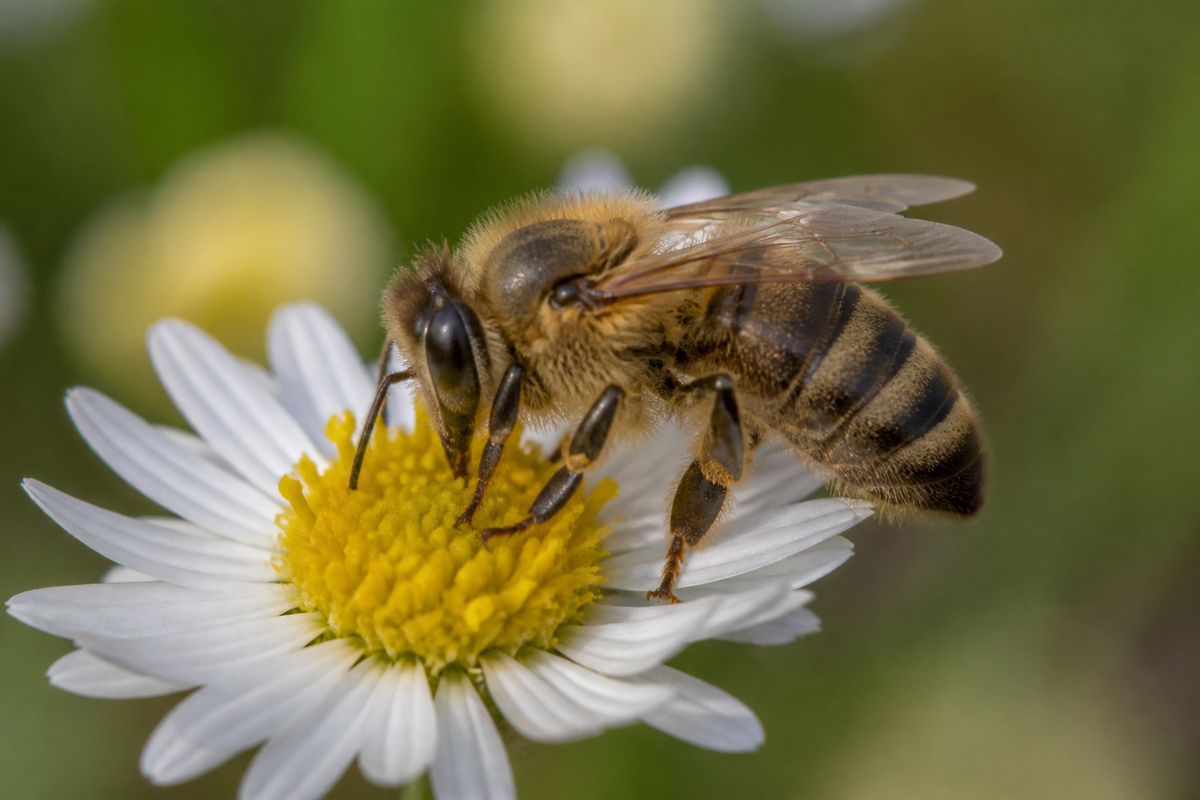
Most workers show alternating bands of amber-brown and black across the abdomen, with the intensity of the yellow varying by individual and by hive. The thorax and much of the abdomen are covered in short branched hairs (setae). These hairs hold an electrostatic charge that pulls pollen grains onto the bee's body as it brushes against a flower's anthers, and they trap a layer of warm air next to the body when the colony is clustering in cold weather.
Color by Subspecies
- Italian honey bee (Apis mellifera ligustica): bright golden-yellow bands, the subspecies most commonly sold to US beekeepers.
- Carniolan honey bee (Apis mellifera carnica): darker brown-gray body with faint striping, bred for gentleness and fast spring buildup.
- Caucasian honey bee (Apis mellifera caucasica): grayish body, one of the darkest commercially kept strains.
Diet, brood-rearing conditions, and age can shade an individual bee's color slightly, but subspecies genetics set the baseline pattern.
Behavior: Caste Roles Inside the Colony
A colony can hold tens of thousands of bees at summer peak, and almost every one of them has a job tied to her age or caste.
Division of Labor
- The queen lays eggs and releases queen mandibular pheromone, which suppresses ovary development in worker bees and helps hold the colony together.
- Young workers (roughly the first two to three weeks of adult life) clean cells, feed larvae, and process nectar inside the hive.
- Older workers shift to guarding the entrance and then to foraging outside the hive for the rest of their six-week working-season lifespan.
- Drones do not forage or defend the hive; their only role is mating with a queen, after which they die. Any drones still present in autumn are typically evicted by workers as the colony conserves winter stores.
The Waggle Dance
Foragers that find a strong nectar or pollen source return to the hive and perform a waggle dance on the vertical comb. The angle of the dancer's straight run relative to straight up on the comb reports the direction to the food source relative to the sun, and the length of the waggle run reports the distance. Nestmates follow along and then fly out using that vector. Karl von Frisch first decoded this language and shared the 1973 Nobel Prize in Physiology or Medicine for the work.
Nectar to Honey
A forager draws nectar up through a straw-like proboscis and stores it in a crop, then passes it to house bees back at the hive. House bees add enzymes and repeatedly regurgitate and reabsorb the liquid, then fan it with their wings to evaporate excess water. The result, sealed under a wax cap once it reaches roughly 17-18% moisture, is honey the colony draws on through winter when no flowers are blooming.
Swarming
When a hive gets crowded and food is abundant, workers raise several new queens in special peanut-shaped cells. Before the first new queen emerges, the old queen leaves with roughly half the workforce to found a new colony elsewhere, and the bees that stay behind raise a replacement queen. A swarm in flight looks alarming but is usually the least defensive a colony ever gets, since the bees have no brood or stores left to protect.
Defense
Worker bees defend the hive by stinging. The stinger and venom sac tear free when a worker pulls away from mammal skin, and the bee dies from that injury, though the detached stinger keeps pumping venom for up to a minute. A sting also releases isopentyl acetate, an alarm pheromone that smells faintly like bananas and recruits nearby guards to the same spot. Queens and drones do not sting defensively; queens have a smooth, usable-multiple-times stinger reserved for rival queens, and drones have no stinger at all.