What Are the Characteristics of Fruit Flies? Wing-Buzz Courtship
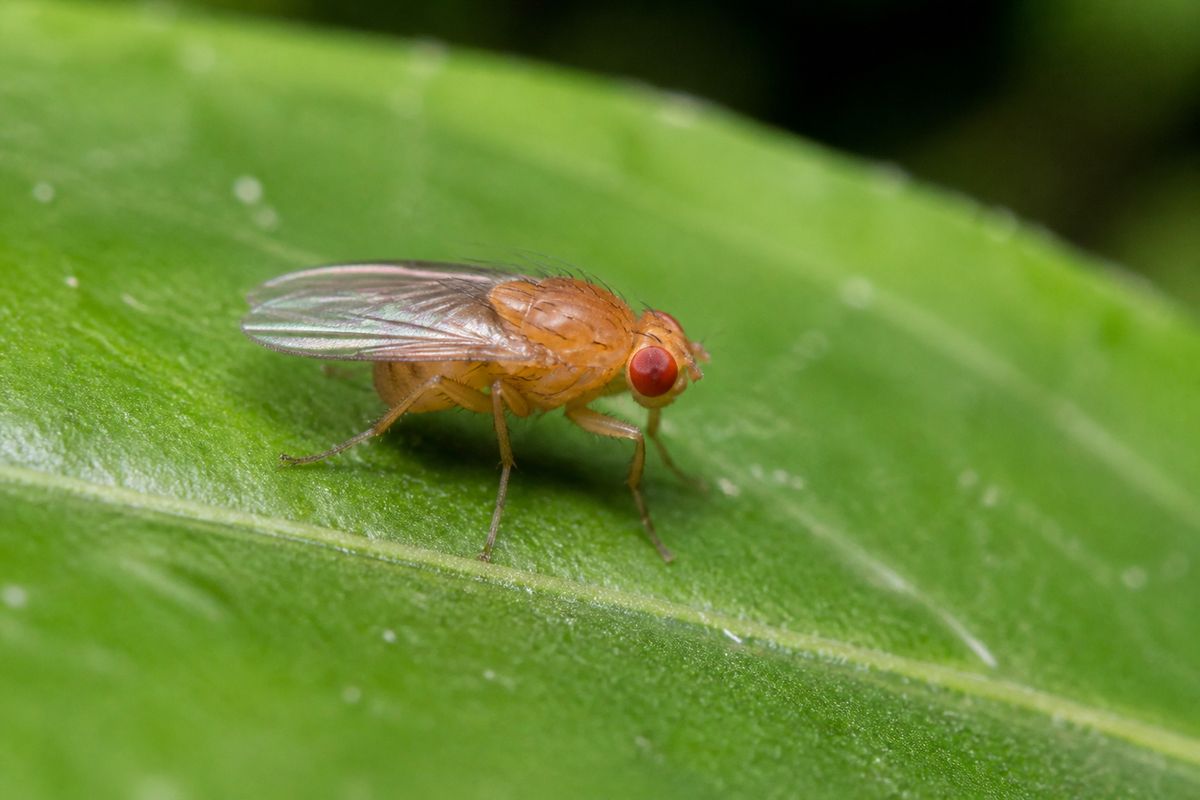
What are the characteristics of fruit flies? Drosophila melanogaster, in the family Drosophilidae, is a 2 to 3 millimeter fly with a yellow-brown body, brick-red compound eyes, and a habit of swarming anything overripe or fermenting in a kitchen. The same traits that make it a household nuisance, fast breeding, tiny size, sensitivity to odor, are also why geneticists have used it as a lab organism for over a century.
Size
Adults run about 2 to 3 millimeters long, with females typically a bit larger than males. That is roughly the length of a grain of rice cut into thirds. The larvae that hatch from eggs are smaller still, which lets them work into the soft tissue of a bruised peach or the film on the inside of a nearly empty soda can.
Small body size is part of why populations climb so fast. A University of Washington fly-genetics outreach page notes that females can lay up to 100 eggs a day, and each egg needs only a smear of yeast-covered, fermenting fruit to develop.
Color and Body Markings
Body
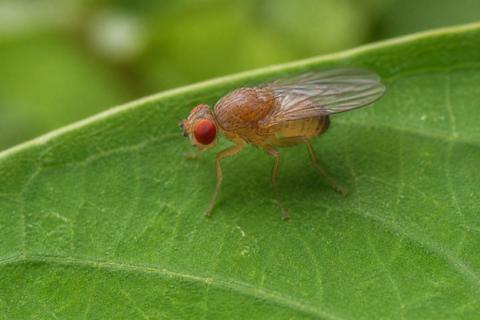
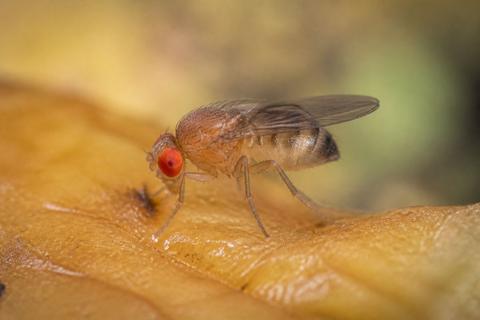
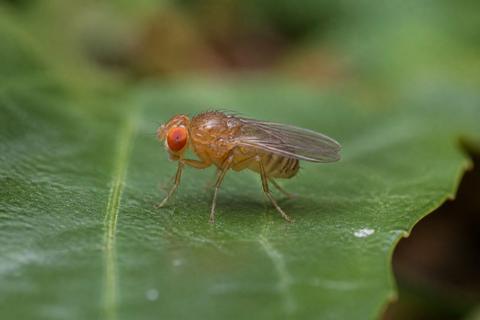
The wild-type body is yellow-brown with dark, transverse bands across the back of the abdomen. Darker banding is more pronounced in males, whose abdomens also end in a more rounded, solid-black tip, one of the easiest ways to sex a fly under a hand lens.
Eyes
The compound eyes are brick red in wild-type flies, large relative to the head, and packed with roughly 750 individual lenses called ommatidia. Lab strains bred for classroom genetics often carry a white-eye mutation, which is why so many textbook photos show white-eyed flies instead of the red-eyed wild type found in the average kitchen.
Bristles
Rows of stiff bristles, called setae, cover the head, thorax, and legs in a fixed, predictable pattern. Entomologists use the exact placement of these bristles to tell Drosophila species apart under magnification, since wing shape and body color alone can be too similar across species.
Behavior
Courtship
Males court females with a fixed sequence: tapping the female with a foreleg, extending one wing and vibrating it to produce a species-specific song, then attempting to mount. The wing song alone can run for several minutes before a female accepts or rejects the male, and researchers have used slowed recordings of it to distinguish closely related Drosophila species that look nearly identical.
Feeding
Fruit flies have sponging mouthparts built for liquids, not solids, so they feed on the yeast growing in fermenting fruit rather than the fruit's flesh itself. Their attraction to a wine glass or vinegar bottle comes from receptors tuned to ethanol and acetic acid, the same compounds yeast produces as it breaks down sugar.
Territoriality
Males stake out patches of ripening or fermenting fruit and will chase off rival males that land nearby, since a productive feeding site doubles as a place to intercept females. Confrontations are typically brief, wing displays and short chases, rather than sustained fighting.
Life Cycle
A Vanderbilt University research guide puts the full egg-to-adult cycle at about 10 days at 25°C (77°F), and 14 to 15 days at 20°C (68°F):
- Egg: Laid singly on fermenting food; hatches in about a day.
- Larva: Three feeding stages (instars) over roughly 4 to 5 days, tunneling through soft, decaying material.
- Pupa: The larva forms a hardened case and undergoes metamorphosis over about 4 days.
- Adult: Emerges sexually immature; mating typically begins within a day or two.
Because a single generation can complete in under two weeks, an ignored problem, like a bowl of soft peaches, can go from a couple of stray flies to dozens in under a month.
Where They Thrive
Fruit flies favor warm conditions, roughly 20°C to 30°C (68°F to 86°F), which covers most kitchens for the majority of the year. Common attractants include:
- Overripe produce: bananas, tomatoes, and apples left out too long.
- Fermented liquids: wine, beer, and vinegar left uncovered.
- Sugary residue: empty soda cans, syrup drips, and unwashed recycling.
Rinsing recycling before it goes in the bin and refrigerating fruit past its prime removes most of what draws them in.
Living With a Fast Breeder
The traits covered here, small size, red eyes, banded coloring, wing-song courtship, and a life cycle measured in days rather than weeks, explain both why fruit flies show up so quickly in a kitchen and why they became one of biology's standard lab animals. Cutting off fermenting fruit and sugary residue addresses the same biology that makes Drosophila useful on a lab bench: no food source, no next generation.