Peppermint Oil for Bed Bugs: Can It Repel Them?
If you are seeing bites, dark spots, or blood smears on your sheets, you probably want peppermint oil for bed bugs to be a fast, simple fix. It is not. Peppermint oil has a strong smell that can make bed bugs move away from a treated spot for a short time, but a smell is not the same thing as killing an infestation, and the lab evidence backs that up.
For more help, see our Homemade Peppermint Pest Repellent Spray (DIY Recipe) guide.
What Peppermint Oil Can and Cannot Do
The short answer: repellency vs. elimination
Peppermint oil for bed bugs works, at best, as a short-term deterrent in a small area, not as a way to end an infestation. Repellency means bugs move away from an odor for a while. Elimination means killing bed bugs in every life stage, including eggs, in every hiding spot. Peppermint oil does the first sometimes and essentially never does the second on its own. In one lab study, a commercial spray containing 1% peppermint oil plus clove oil and sodium lauryl sulfate killed more than 90% of bed bug nymphs on direct contact, but the same product showed no measurable repellency once a carbon dioxide source (a stand-in for a sleeping person's breath) was introduced, and it still underperformed conventional insecticides in choice tests (Feldlaufer & Ulrich, 2015). In plain terms: the oil has to physically land on the bug to do anything, and even then it will not stop hungry bed bugs from moving toward you.
- Treat peppermint oil as a minor add-on, not a treatment plan.
- Plan for the real work: inspection, laundering, heat, steam, vacuuming, and sealing.
- Call a professional once an infestation is active and spreading.
Why bed bugs are hard to kill with household remedies
Bed bugs hide in mattress seams, bed frame joints, headboards, and hairline cracks behind baseboards and outlet covers. A spray, oil, or wipe-down only affects bugs it directly touches, and most of a bed bug population at any given time is tucked into a gap a spray bottle never reaches. Females can lay several eggs a day and hundreds over a lifetime, so one missed pocket can restart the problem within weeks. Eggs are also largely unaffected by contact sprays, including essential-oil ones, which is a big part of why scent-based remedies stall out.
- Prioritize tools that kill or physically remove bugs: heat (dryer, steam) and vacuuming.
- Add containment: mattress and box-spring encasements rated for bed bugs.
- Do not expect a single treatment to finish the job when eggs are present; plan on follow-ups roughly one to two weeks apart to catch newly hatched nymphs.
How peppermint's smell may affect bed bug behavior
Peppermint essential oil is mostly menthol and related menthol-family compounds, and strong odors like this can interfere with how bed bugs sense their surroundings. Bed bugs navigate largely by scent, so a concentrated mint smell near a harborage can make them hesitate or relocate for a while. That is the entire mechanism, an unpleasant smell, not a toxic one at typical household concentrations. Once the scent fades, which happens quickly because essential oils evaporate, bed bugs go back to normal behavior.
Do not read "they moved away from the spot I sprayed" as "the infestation is under control." It usually just means they relocated a few inches to an untreated seam.
- Use peppermint scent as a short-term nudge in one small area, not whole-room protection.
- Do not skip your inspection and cleaning plan while you wait to see if the smell "works."
- Expect the effect to fade within hours as the oil dries and the scent disperses.
How to Use Peppermint Oil as a Minor Deterrent (If You Try It)
A basic dilution that will not ruin fabric or surfaces
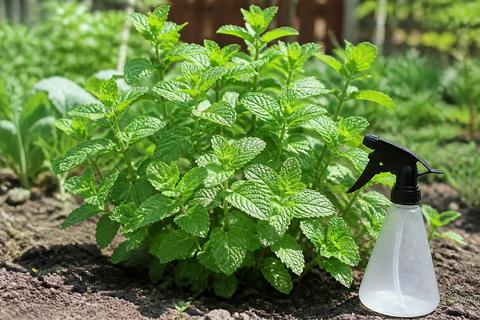
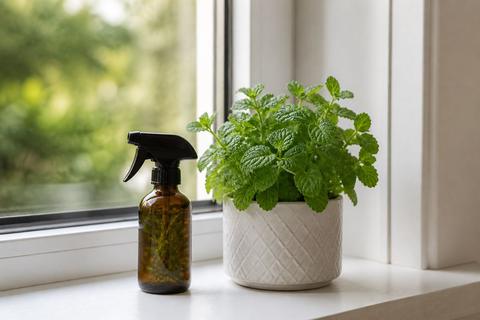
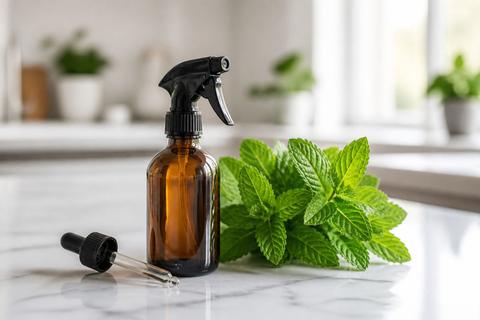
If you want to try it anyway, keep the mix simple and weak enough to be safe on hard surfaces: 10 to 15 drops of pure peppermint essential oil, a drop or two of unscented dish soap to help the oil mix into the water instead of floating on top, and 1 cup of water in a spray bottle. Shake before every use since the oil will separate again within minutes. This is a scent-and-mild-contact mix, not a pesticide-strength formula, so do not expect it to match the lab results above, those used purpose-built commercial formulations, not a homemade spray.
- Spray lightly on non-porous, non-fabric surfaces: baseboards, door frames, outlet plate edges, luggage exteriors.
- Let it dry fully before anyone touches the surface.
- Avoid mattresses, upholstery, and bedding entirely (see the fabric-damage section below).
Reapplication cadence, and why it needs to be frequent
Essential oil scent is not durable. Plan to reapply every 2 to 3 days indoors, and immediately after cleaning, steaming, or wiping down a treated surface, since all of those remove the residue. If you are using it near an entry point that gets washed, mopped, or rained on (a doorway threshold, a window track), reapply right after. Because the scent fades this fast, peppermint oil cannot function as a standing barrier the way a residual insecticide can; it is a between-cleanings touch-up at most.
- Reapply every 2 to 3 days as routine maintenance.
- Reapply immediately after any wiping, mopping, or laundering of the treated surface.
- Do not stretch intervals longer to save oil; a faded application does nothing.
Which pests this actually affects, and which it does not
Peppermint oil's evidence base is strongest, and still modest, for soft-bodied insects it directly contacts in lab conditions, and it has some documented deterrent activity against certain ants and spiders in and around structures. Its performance against bed bugs specifically is limited to the direct-contact effect described above, with no meaningful repellency once a bed bug is cued by carbon dioxide or body heat. It is not an effective treatment for cockroaches, fleas, or lice; for lice in particular, treat any peppermint-based claim as unproven and use a comb-and-product protocol instead.
- Do use it, at most, as a minor contact irritant or short-term deterrent for surface-active bugs like ants.
- Do not rely on it for bed bugs, roaches, fleas, or lice as a stand-alone control method.
- Do not assume "natural" means broad-spectrum; different pests respond very differently to the same oil.
Safe Use Around Skin, Bedding, and Pets
Why peppermint oil should never go on skin undiluted
Undiluted peppermint essential oil is concentrated enough to cause burning, redness, or a rash, and it can trigger allergic reactions in people with sensitive skin. Putting it on your body also does not create a personal bed bug barrier, bed bugs bite where skin is exposed and accessible regardless of a mint smell a few inches away, so there is no safety trade-off that makes this worth the irritation risk.
- Never apply peppermint essential oil directly to skin, diluted for a spray or not.
- Do not use it as a personal repellent against bed bug bites.
- Keep it away from eyes, mouth, and broken skin.
Risks to children, pets, and people with sensitive skin
Cats in particular are more sensitive to essential oil exposure than dogs or people, and they can pick up residue through grooming even from a surface they only brushed against. Inhaled essential oil vapor can also irritate the airways of small children and anyone with asthma. A treated room smelling strongly of peppermint is not a sign it is safe for pets or kids to enter.
- Keep children and pets out of a treated room until the surface is fully dry and the smell has faded.
- Never spray anywhere a pet sleeps, climbs, or licks.
- Stop use and seek medical advice if anyone develops redness, coughing, or breathing trouble.
Why sprays on mattresses and bedding cause new problems
Spraying peppermint mixture directly onto mattresses or bedding can stain or degrade fabric finishes, and oil residue does not always wash out completely, which raises the odds of skin irritation later. Worse, misting the outside of a mattress treats exactly the surface bed bugs are not living in, since they are tucked into seams, tufts, and frame joints underneath. You end up with a mint smell and a residue problem, not fewer bed bugs.
- Do not spray peppermint mixture into mattress seams or onto sheets and pillowcases.
- Use heat, hot laundering, and steam for bedding and washable items instead.
- If you use any scent product at all, keep it strictly off contact surfaces.
What Actually Works Better Than Peppermint Oil
Heat treatment, steam, and targeted laundering
Heat kills bed bugs and their eggs, which is more than any essential oil does. Use your dryer for washable items and a garment or handheld steamer for seams, tufts, and cracks in furniture that cannot be laundered.
- Wash bedding and clothing on the hottest cycle the fabric allows.
- Dry on high heat for at least 30 minutes and keep items tumbling so heat reaches evenly.
- Steam mattress seams, bed frame joints, and nearby baseboard edges slowly so the heat penetrates, not just the surface.
- Repeat steaming on a schedule (roughly every 1 to 2 weeks) since eggs that survive the first pass will keep hatching.
Vacuuming, encasements, and reducing hiding places
Vacuuming physically removes live bugs and debris when you cover the right spots with the right technique. Follow it with encasements to trap anything that survives.
- Vacuum mattress seams, headboard edges, bed frame joints, and baseboards along the floor.
- Empty the vacuum immediately into a sealed bag outdoors, then discard the bag.
- Install mattress and box-spring encasements rated for bed bugs and leave them on for at least a year.
- Declutter within about 6 feet of the bed, especially clothing piles and cardboard boxes.
When to call a licensed pest-control professional
Call a professional once bed bugs are confirmed, bites keep appearing, or you find multiple life stages (eggs plus nymphs plus adults). Professionals can access harborages you cannot reach safely and use treatments calibrated for actual kill rates, something a homemade spray cannot match.
- Contact a pro if you see eggs, multiple adults, or bed bugs in more than one room.
- Call sooner in an apartment or shared wall situation, since bed bugs move between units.
- Ask for an inspection first, then a written plan with follow-up visit timing.
Peppermint and Other Common Search Questions
Does peppermint oil help with lice, too?
People search for peppermint oil for lice for the same reason they search for it for bed bugs, the smell feels like it should do something. Evidence for peppermint specifically against lice is thin, and it is not a substitute for fine-tooth combing and an established lice treatment product. Lice attach eggs directly to hair shafts close to the scalp, a mechanism scent cannot disrupt.
If you are dealing with lice, follow guidance from a pediatrician or pharmacist rather than a home remedy, and avoid putting any essential oil directly on a scalp.
Peppermint shampoo, peppermint tea, and bedtime myths
Peppermint tea and "drink this before bed" claims do not reach bed bugs or lice in any way that matters, there is no route from your stomach to an insect's biting behavior. Peppermint shampoo may leave a scent on hair, but scent does not kill lice eggs cemented to hair shafts, and it does nothing for bed bugs hiding in furniture.
- Do not rely on drinks, shampoos, or bedtime routines for pest control.
- Match the method to the pest: heat and encasements for bed bugs, combing and medicated treatments for lice.
- Treat essential oils as a minor supplement at best, never the primary plan.
Why a pleasant scent does not equal pest control
Bed bugs do not need a bad smell to survive, they need access to a host and an undisturbed hiding spot. A mint odor can nudge behavior briefly right where it lands, but it does nothing for the bugs sitting in a seam three inches away. That is why a room can still produce fresh bites after every visible surface has been sprayed.
- Replace scent-based hope with targeted inspection and physical control.
- Use a flashlight and inspection, not smell, to judge whether treatment is working.
- Measure progress by fewer sightings and bites over 2 to 3 weeks, not by how strong the room smells.
Practical Next Steps If You Suspect Bed Bugs
How to confirm an infestation before treating it
Confirm before you treat, since flea bites, other allergic reactions, and carpet beetle debris can all mimic bed bug signs. Look for live insects, shed skins, or small dark specks (droppings) along mattress seams, box springs, bed frames, and headboards first, then check outlets, drawer joints, and any luggage recently brought into the room.
- Use a bright flashlight and a stiff card to check seams, folds, and tufts.
- Look for live bugs (small, flat, reddish-brown) or eggs (tiny, pale, glued to surfaces).
- Photograph anything you find so a pest-control professional can confirm species and severity.
What to isolate, wash, or inspect first
Start with whatever touches the bed directly: bedding and nearby clutter. Bag laundry before moving it to avoid spreading bugs to other rooms, then wash and dry on the highest heat the fabric tolerates.
- Strip the bed and seal sheets and clothing into bags or bins before carrying them anywhere.
- Wash and dry on high heat for anything that can tolerate it.
- Bag non-washable items and inspect their seams and folds before deciding next steps.
- Check nightstands and power strips near where the bed frame meets the wall.
A simple response plan for the next 24 hours
The first day is about containment, physical removal, and documentation, not chemical treatment of any kind.
- Bag laundry at the door; do not carry it loose through the home.
- Vacuum mattress seams, bed frame joints, and floor edges near the bed, then discard the vacuum bag outdoors.
- Run the highest heat cycle on washable bedding and clothing, then dry on high for at least 30 minutes.
- Inspect headboard seams and nearby cracks and photograph anything you find for a follow-up visit.
Frequently Asked Questions
Does peppermint oil keep bed bugs away?
It can act as a mild, short-lived deterrent in a small treated area, largely because bed bugs dislike the concentrated menthol smell up close. It is not a reliable way to keep bed bugs out of a room or off a bed.
Does peppermint oil get rid of bed bugs?
No. A homemade peppermint spray is not a bed bug killer. Lab tests on a purpose-built commercial peppermint-oil product showed contact kill on nymphs but no repellency once a host cue was present, and even that product was less effective than standard insecticides (Feldlaufer & Ulrich, 2015).
Can I use peppermint oil as a bed bug repellent on skin?
No. Undiluted peppermint oil can irritate skin, and even properly diluted it will not create a dependable barrier against bites.
Do bed bugs hate peppermint?
They may avoid a strong, fresh application for a short time, but that is not the same as reliable repellency, and the effect disappears once the scent fades.
Why isn't peppermint oil EPA-registered as a bed bug pesticide?
Peppermint oil qualifies as a federal "minimum risk" pesticide ingredient, which means the EPA exempted it from registration based on its low health and environmental risk, not because its pest-control efficacy was tested and confirmed (EPA, Minimum Risk Pesticides). In practice, that means no federal agency has verified how well it actually works against any specific pest, including bed bugs.
Does peppermint help with lice the way people claim it helps with bed bugs?
Evidence is limited for both. Peppermint shampoo or scent products are not a substitute for proven lice combing and treatment protocols, just as they are not a substitute for heat and physical removal for bed bugs.