Where Do Red Admiral Butterflies Live? A Migratory Range
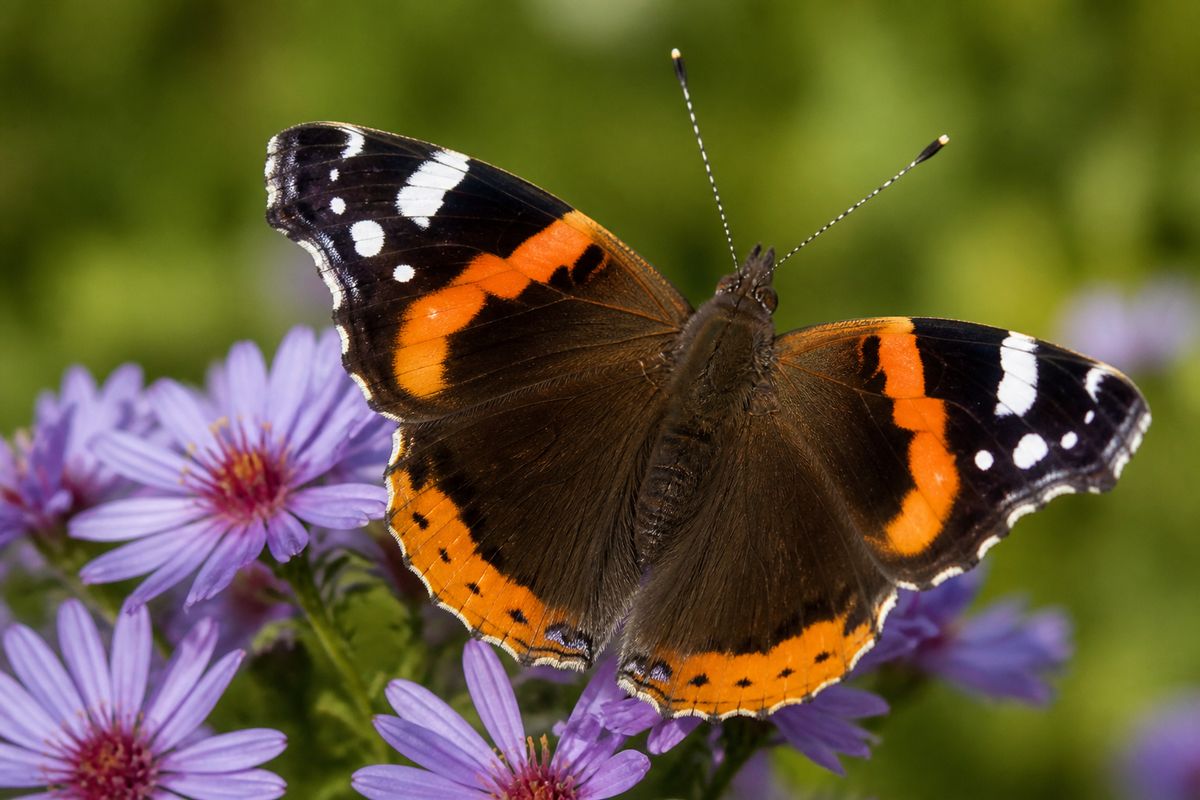
Where do Red Admiral butterflies live? Vanessa atalanta turns up almost anywhere it can find nettles and a patch of sun, from woodland edges and backyard gardens to coastal dunes and mountain meadows. The wings are black with an orange band across the forewing and orange trim on the hindwing, with a wingspan of 1.75 to 2.50 inches, and adults rarely sit still for long, cruising in short, fast bursts between basking spots.
What the Adult Looks Like
The Red Admiral is a mid-sized nymphalid. The upperside is mostly black with a bright orange-red band slashing across each forewing and a matching orange border along the hindwing edge, plus small white spots near the forewing tip. The underside is mottled brown and blue-grey, which reads as bark or dead leaf when the wings close, hiding the butterfly from birds while it rests on a tree trunk.
Size and Flight
- Wingspan: 1.75 to 2.50 inches (about 4.5 to 6.5 cm).
- Flight style: fast, erratic wingbeats with frequent glides; adults are territorial and will chase off other butterflies, even ones larger than themselves.
- Adult lifespan: several weeks in summer; individuals that enter reproductive diapause in fall can survive into the following spring.
Egg to Adult
Females lay single pale green eggs on the top of a host leaf. The caterpillar pulls the leaf edges together with silk to build a shelter and feeds from inside it, building a larger shelter as it outgrows the last one through several molts before eventually pupating. Development time from egg to adult varies with temperature, running from a few weeks in warm conditions to considerably longer in cooler weather.
Habitat: Where They Actually Settle
Red Admirals are not picky about scenery as long as two things are present: a nettle-family host plant for caterpillars and open, sunny patches for adults to bask and feed. That combination shows up in a wide range of places.
Where to Find Them
-
Woodland edges and clearings: Sunlit gaps along tree lines warm up fast and often have wild nettle growing at the margin, making them a reliable spot to see adults basking with wings spread.
-
Gardens and yards: A patch of stinging nettle left to grow, paired with flowering shrubs nearby, is often enough to draw Red Admirals into a residential garden.
-
Fields, meadows, and roadside verges: Open ground with wildflowers and disturbed soil, where nettles tend to colonize, supports both feeding adults and egg-laying females.
-
Coastal dunes and bluffs: Migrating individuals follow coastlines and stop at salt-tolerant flowering plants to refuel.
-
Parks and urban green space: Benches, fences, and bare patches of trail absorb heat and give adults a place to bask between short foraging flights.
Why Temperature Drives Habitat Choice
Red Admirals are not cold-tolerant as adults, which is the main reason their habitat use shifts through the year. Activity picks up as daytime temperatures warm in spring, and colder regions simply go quiet in winter because the butterflies have moved on or died off locally rather than toughed it out in place.
Range: A Butterfly That Recolonizes Rather Than Stays Put
The species ranges across North America, Europe, North Africa, and temperate Asia, plus Hawaii, New Zealand, and some Caribbean islands. That range map hides an important detail: much of it is repopulated every year rather than occupied year-round.
North America
In North America the range runs from northern Canada south through the continental United States into Mexico and Central America. Because adults are not tolerant of cold, most of North America must be recolonized each year from the south, with migrants moving north from overwintering populations in the southern United States as temperatures rise. That is why Red Admirals seem to appear suddenly in a region in spring rather than being visible all winter.
Europe, North Africa, and Asia
European populations range from Scandinavia down to the Mediterranean and North Africa, with the same north-south seasonal shuffle: southern and coastal populations survive winter, then send migrants north as temperatures rise. Some individuals overwinter as adults in sheltered spots such as bark crevices or leaf litter in milder parts of this range. In Asia, populations in Japan and China follow a similar warm-season pattern tied to nettle availability.
Food Sources That Anchor a Habitat
Adults are less picky about flowers than most butterflies expect. Adults will nectar, but prefer tree sap, fermenting fruit, and bird droppings, which is one reason Red Admirals show up around orchards and compost piles as readily as flower beds.
Nectar and Sap Sources
- Butterfly bush (Buddleja davidii)
- Coneflower (Echinacea)
- Asters
- Rotting or fallen fruit, and sap flows on injured trees
Caterpillar Host Plants
Caterpillars feed almost exclusively on plants in the nettle family:
- Stinging nettle (Urtica dioica)
- Wood nettle (Laportea canadensis)
- False nettle (Boehmeria cylindrica)
A stand of any of these is usually the single best predictor of whether a site will host a breeding population rather than just passing adults.
Habitat Pressure and What Helps
Red Admirals are not listed as threatened, but mowing or herbicide programs that wipe out roadside and field-edge nettle patches remove the one plant group their caterpillars depend on. A few habitat moves make a measurable difference:
- Leaving a nettle patch unmown in a corner of the yard or field edge.
- Keeping woodland edges and meadow margins intact rather than clearing them to bare turf.
- Planting nectar sources like coneflower and aster near any nettle patch to support both stages of the life cycle.
- Cutting back on broad-spectrum pesticide use near host plants during spring and summer.
A Butterfly Built for Movement
The short version: Red Admirals live wherever nettles and sun overlap, and their range map is really a snapshot of a population on the move, pushing north each spring and pulling back south each fall. That migratory habit, more than any single habitat type, explains why the species turns up in gardens, coastlines, and forest edges across four continents.