Where Do Blue Morpho Butterflies Live? Mexico to Paraguay
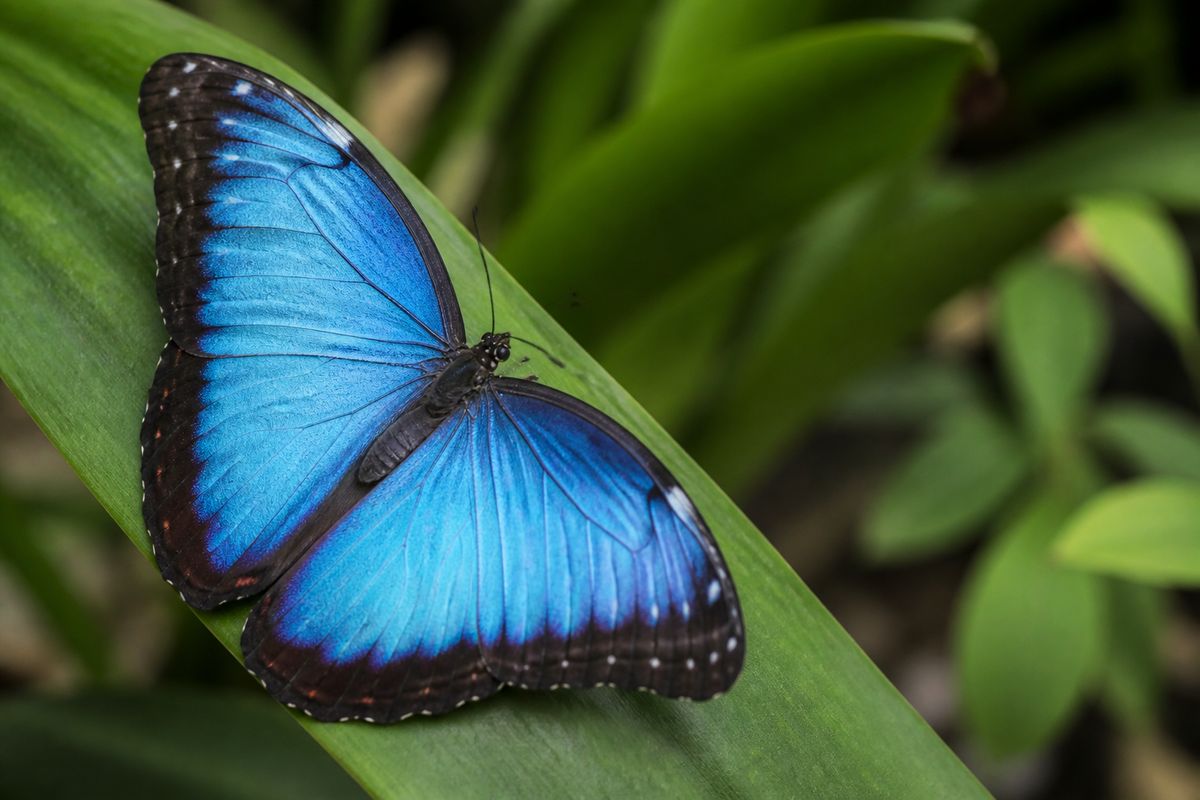
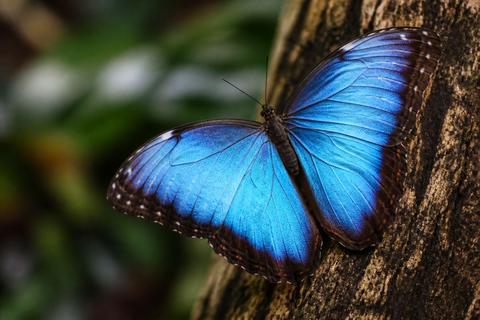
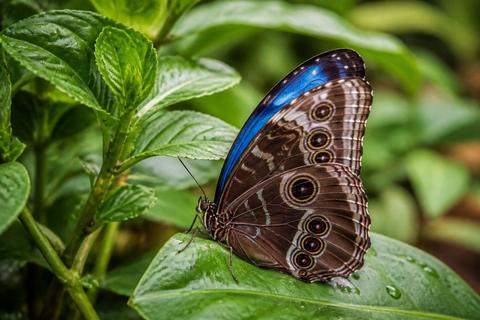
Where do Blue Morpho butterflies live? Morpho peleides ranges from Mexico through Central America and south through the Amazon Basin as far as Paraguay, with an adult wingspan of roughly 5 to 8 inches. The blue you see on the upper wing surface isn't pigment at all; microscopic ridges on the wing scales bend light and reflect it back as that electric, shifting blue. Flip a resting Morpho over and the color disappears, replaced by mottled brown with eyespots that make the closed-wing butterfly nearly invisible against leaf litter.
Rainforest Interior and Edge Habitat
Blue Morphos spend most of their time close to the ground, moving through gaps in the canopy rather than flying above it. They favor sunlit trails, riverbanks, and clearings inside otherwise shaded forest, since these openings warm quickly and let the butterflies bask before their morning flights. The University of Florida's IFAS Extension notes the species is regularly seen along paths, forest edges, and rivers, and builds its largest populations in areas of secondary plant growth rather than deep, undisturbed forest.
Why Secondary Growth Works in Their Favor
Secondary forest, the tangle of young trees and vines that fills in after logging or a cleared farm plot is abandoned, produces exactly the conditions Morpho caterpillars need: fast-growing legume shoots for larvae to chew and open, sunny gaps for adults to patrol. A pristine old-growth canopy, by contrast, often has less of this low, sunlit understory. That's part of why Blue Morphos turn up at eco-lodges and forest-edge trails as often as in remote wilderness.
Elevation Range
Populations occur from lowland rainforest up into cooler montane cloud forest, giving the species a broad elevation range across its territory. In Colombia's Andean foothills, for instance, Morphos share cloud-forest slopes with a different mix of flowering plants than their lowland Amazon relatives use.
Geographic Range
Mexico and Central America
The northern edge of the range sits in southern Mexico. From there, Morpho peleides is established across Belize, Guatemala, Honduras, Nicaragua, Costa Rica, and Panama, generally in lowland and mid-elevation tropical forest.
South America to Paraguay
South of Panama, the range continues through Central America and South America down to Paraguay, taking in Colombia, Venezuela, Ecuador, Peru, and Brazil's Amazon Basin along the way. Several regional subspecies are recognized across this range, including populations on the island of Trinidad. Within this range, the Amazon Basin holds the largest and most continuous populations because it offers the most unbroken tropical forest.
What Determines Where a Population Settles
Temperature
Morphos are ectothermic, so ambient heat drives their activity directly. They fly during the warmest, most humid parts of the day and settle into deep shade to cool off when temperatures spike. Populations don't persist where nights turn cold for extended stretches, which is the main reason the range stays within the tropics rather than pushing into temperate latitudes.
Host Plants for Caterpillars
Morpho peleides larvae feed on a broad range of legumes rather than a single plant. Documented host genera include Machaerium, Dalbergia, Lonchocarpus, Mucuna, Platymiscium, Pterocarpus, Erythrina, and Swartzia. Because the larvae can use so many related legume species, a forest doesn't need one specific plant present to support Morphos, just a reasonable diversity of legume shrubs and vines. Caterpillars feed mainly at dawn and dusk, and the reddish-brown larvae carry hair tufts along their bodies.
Predator Pressure
The camouflaged underside and erratic, bounding flight pattern both work against birds and other visual predators. Where predator density is lower, for example in some secondary-growth patches with fewer perching sites for birds, Morpho numbers tend to run higher.
Deforestation and Habitat Loss
Cattle pasture and row-crop agriculture have replaced large tracts of lowland forest across Central America and the Amazon fringe, and that conversion removes both the host legumes and the shaded microclimate larvae need. Because Morphos rely on forest edges as much as forest interior, a landscape doesn't have to be fully cleared to lose its population; fragmenting the canopy into small, isolated patches can be enough, since it removes the connected corridors adults use to move between feeding and breeding sites.
Protected Areas and Ongoing Research
National parks and private reserves across Costa Rica, Panama, and the Amazon Basin protect significant Morpho habitat, and butterfly houses in several of these countries display live Morphos, giving some forest patches added economic value tied to standing habitat rather than cleared land. Researchers continue tracking population structure across differing land uses to understand how much fragmented, secondary habitat a population can tolerate before numbers drop.
Spotting One in the Wild
Look along sunlit forest trails and riverbanks in the early-to-mid morning, when Morphos are most active and their blue flashes are easiest to catch against green foliage. A folded-wing Morpho resting on bark or leaf litter is genuinely hard to spot, so the flash of blue in flight is usually the giveaway rather than a stationary sighting.