What Is the Life Cycle of Blue Morpho Butterflies? Egg to Adult
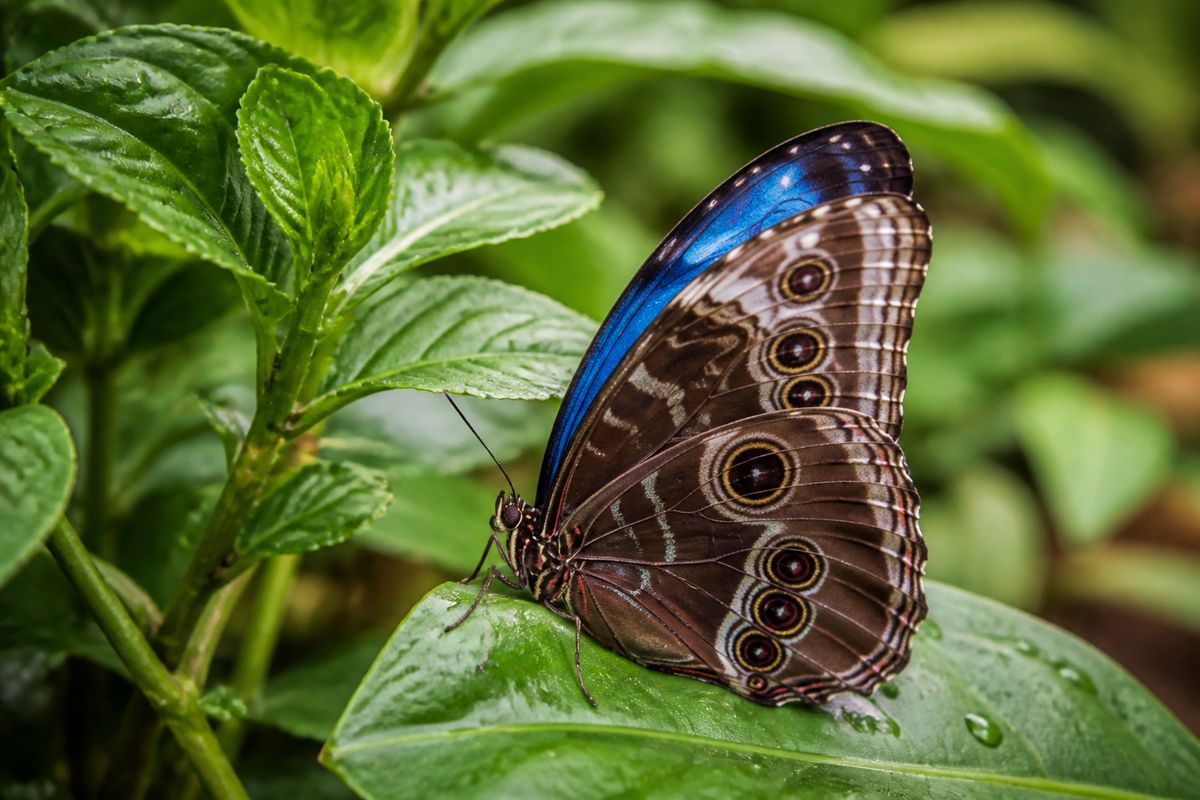
What is the life cycle of blue morpho butterflies? Morpho peleides passes through four stages, egg, caterpillar, chrysalis, and adult, over roughly two to three months before it ever takes flight. Each stage looks almost nothing like the one before it, which is part of why this species is such a common example of complete metamorphosis in butterfly houses and classrooms alike.
Stage 1: Egg
A female blue morpho lays her eggs on the underside of leaves belonging to legume host plants, positioning them where hatching larvae will have food within reach. She is choosy about placement, since a caterpillar that hatches on the wrong plant may not survive its first day.
-
Egg characteristics: The eggs are hemispherical, roughly 1 to 2 millimeters across, pale green, and marked with a ring of small brown spots near the top.
-
Incubation period: Eggs hatch in 7 to 16 days depending on the subspecies, with warmer, more humid conditions generally shortening the wait.
Stage 2: Larva (Caterpillar)
Hatchlings emerge as caterpillars barely 5 millimeters long and immediately start eating. Growth in this stage is fast and visible, since the caterpillar sheds its skin each time it outgrows it.
-
Appearance: Young larvae are green-yellow with maroon patches and tufts of red and white hairs. The caterpillar molts through five instars, and by the final one its color has shifted to a mottled brown that blends into leaf litter.
-
Feeding habits: Larvae feed on legume foliage, including Machaerium, Mucuna, Pterocarpus, and Erythrina species, plants in the pea family that supply the protein needed for rapid growth.
-
Duration: The larval stage runs roughly 7 to 10 weeks across its five instars and ends when the caterpillar, now close to 90 millimeters long, stops eating and searches for a place to pupate.
Stage 3: Pupa (Chrysalis)
Metamorphosis happens inside a chrysalis the caterpillar builds from its own final molt. Almost every internal structure the caterpillar had is broken down and rebuilt during this stage.
-
Formation: The caterpillar anchors itself with a silk pad, sheds its skin one last time, and hardens into a pale green, oval-shaped chrysalis that can pass for a curled leaf.
-
Metamorphosis: Inside, the caterpillar's tissues reorganize into wings, legs, antennae, and the other structures of an adult butterfly. The chrysalis stage lasts approximately 14 days.
-
Emergence: The adult pulls free of the chrysalis with soft, folded wings, then pumps hemolymph into the wing veins to expand and stiffen them before its first flight.
Stage 4: Adult Butterfly
A newly emerged blue morpho spends its adult life feeding, defending territory, and finding a mate, all while carrying wings built for both display and camouflage.
-
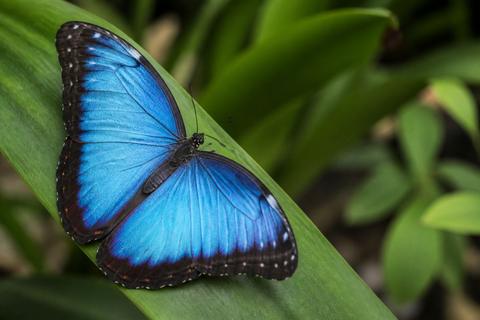
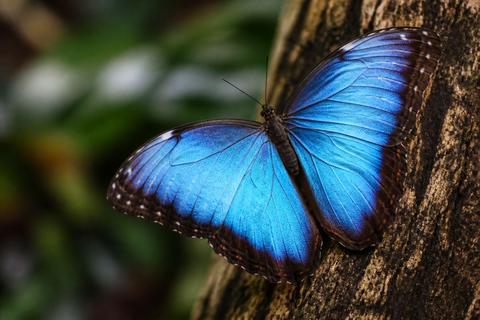
Appearance: Adult wingspans run 5 to 8 inches (127 to 203 millimeters), among the largest of any butterfly in the Americas. The dorsal surface flashes iridescent blue, while the undersides are brown with eyespots that break up the butterfly's outline at rest.
-
Feeding: Unlike most butterflies, adults are frugivores that feed on decaying fruit rather than flower nectar, using a proboscis to draw up the juices of fermenting fruit fallen on the forest floor.
-
Mating behavior: Males patrol stretches of forest edge, flashing their blue uppersides in flight to signal to females and rival males before pursuing a mate.
-
Lifespan: Most adults live several weeks; predation by birds, jacamars, and lizards, along with weather, determines whether an individual reaches the longer end of that range.
Facts Worth Knowing About Blue Morpho Butterflies
-
Range: Blue morphos live in forests from Mexico through Central America and south to Paraguay, favoring montane and lowland forest edges with plenty of secondary growth.
-
Defense: A resting morpho keeps its wings closed to show the cryptic brown underside; startled, it snaps them open to flash blue and bolts in an erratic, hard-to-track flight path.
-
Eyespots: The eyespots on the ventral wings can startle a bird into hesitating just long enough for the butterfly to escape a strike aimed at its body.
-
Structural color: The blue is not pigment. Microscopic ridges on the wing scales scatter light so only blue wavelengths reflect back, a phenomenon that has drawn interest from optics researchers studying anti-counterfeiting and sensor materials.
-
Cultural use: The wings show up in jewelry and framed art across Central and South America, and live morphos are a signature exhibit species in butterfly conservatories.
-
Conservation: Blue morphos are not currently listed as threatened, but deforestation across their range shrinks the secondary-growth forest edges they depend on for host plants and fruit.
From Egg to Iridescent Flight
A blue morpho spends roughly two to three months as an egg, caterpillar, and chrysalis before it ever shows its blue, and then lives only a few more weeks as the adult most people picture when they hear the name. That short adult window is why the earlier stages matter so much: a healthy population depends on host plants for the larvae and rotting fruit on the forest floor for the adults, not just on the trees where the butterflies are seen flying.